Isomux Backstory
In January, I read Steve Yegge's Gas Town post where he shows the following hierarchy:
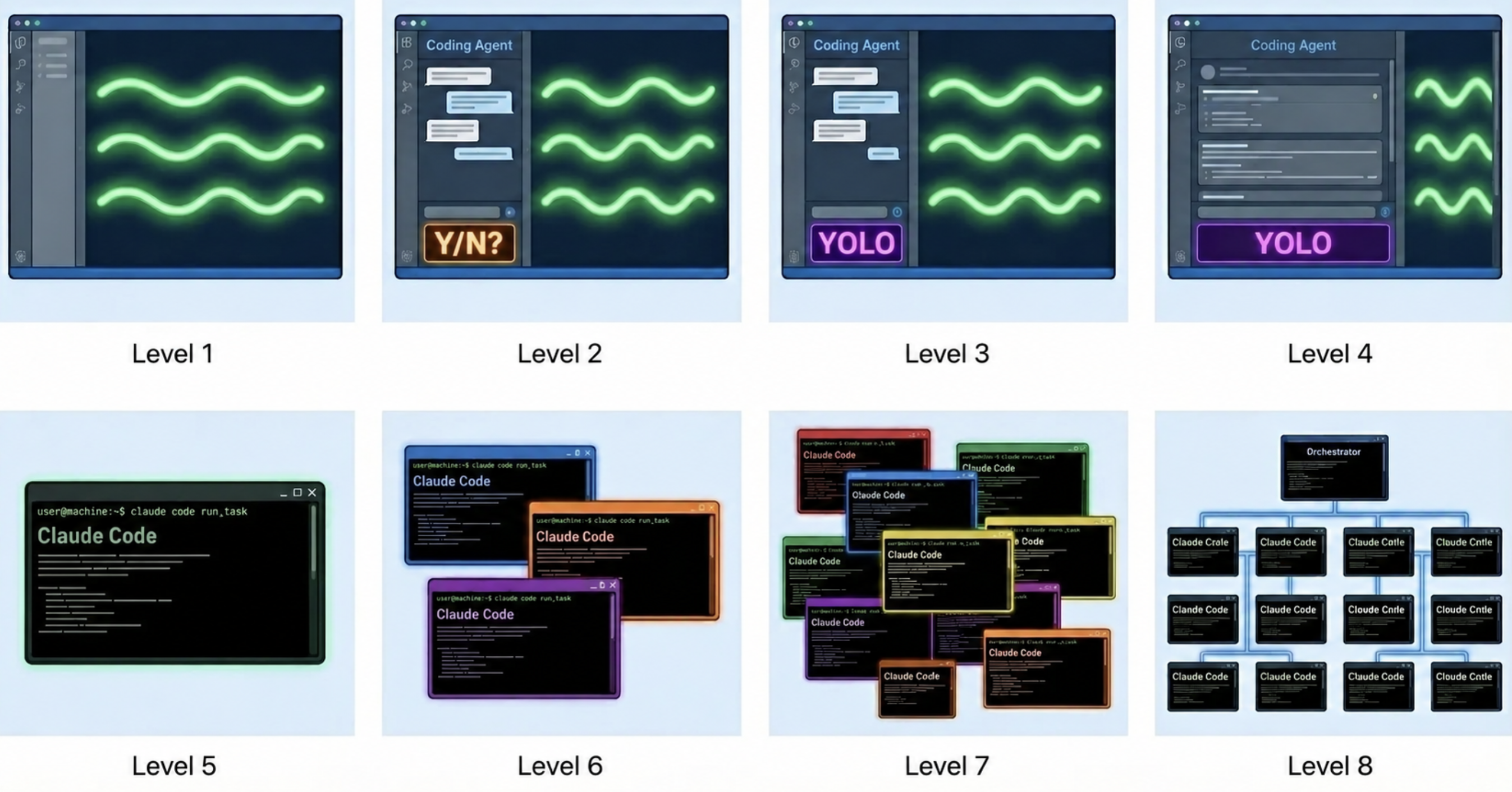
I was at Level 5. The post warns you not to try to jump straight to Level 8, so I asked myself what was one thing I could pick up from it to help me up the hierarchy.
That one thing was tmux (short for Terminal MUltipleXer). It helped me manage a few Claude Code sessions at once, but I didn't want to spend all day every day looking at terminals. So I got a bit creative and made a wrapper that was cuter to look at, with isometric graphics. Hence Isomux (ISOmetric MUltipleXer):
That started a pattern: using agents to solve pain points in my environment.
For example, another pain point was having to manage a mix of local and remote sessions.1 For the former, I had to keep my laptop open. For the latter, I had to ssh all the time.
So I moved Isomux to a server. This way:
- All my devices see the same agents and conversations.
- All my agents outlive my laptop and see the same environment.
Over time, I developed Isomux into a meta-harness:
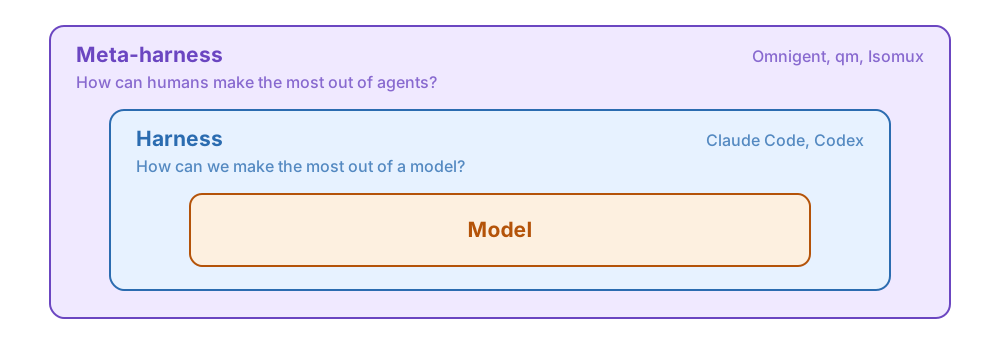
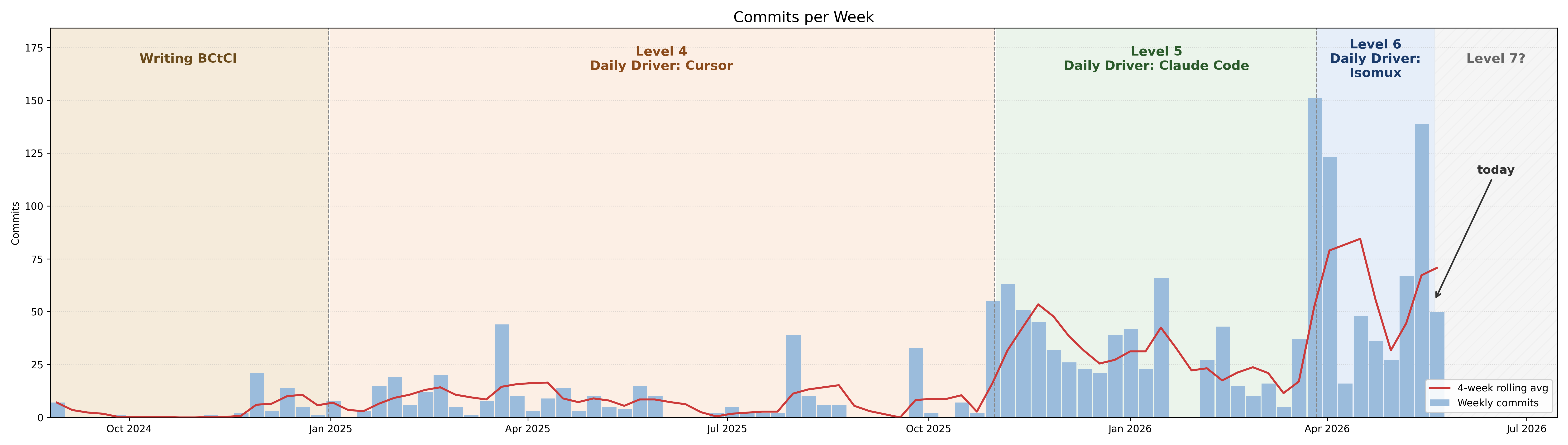
I started Isomux on March 27, 2026, and I built it from inside it since that day.2 In fact, I haven't used anything else since (except on occasions where I managed to brick Isomux during development and used "bare bones" Claude Code to unbrick it).
And yes, it helped me go up the Steve Yegge hierarchy:
Office Metaphor
In January, I also saw Vibecraft, which shows Claude Code sessions as animated characters. That planted the idea of anthropomorphized agents.
The office metaphor comes from trying to make agents more accessible to non-technical folks. The idea is that talking to an agent should feel like talking to a coworker - something relatable to everyone.
Each agent has a customizable name and look and sits at a desk. You see who is working, who's sleeping, and who needs you (hand raised) at a glance.
Timeline
- Mar 27, 2026: First commit.
- Mar 28: Multi-device and multiplayer (in the same VPN). The same office, live on laptop and phone. Messages carry the sender's name, so several people can talk to the same agents.
- Apr 3: Published Isomux: Designing a Meta-Harness.
- May 9: Agent-to-agent messaging.
- May 10: Multi-provider. Codex agents, side by side with Claude Code agents.
- May 14: Member accounts with invite links (multiplayer no longer restricted to the same VPN).
- Aug 8: Published Making Agents User-Friendly.
- Aug 24: Turned Isomux into a company and launched my first product, Hosted Isomux (isomux.app). See Building a Hosted Agents Product End-to-End.
- Aug 28: Published The Personal App Store.
- Sep 30 and Oct 5: Published Isomux for Enterprise (part 1, part 2).
By May, Isomux had all four of multi-user, multi-agent, multi-device, and multi-provider in the same conversation; as of October, I haven't found another product that does.3
Footnotes
-
Tasks like model training can only be done remotely. ↩︎
-
Here's Isomux on its first day, next to how it looked in August. ↩︎
-
The Isomux dates are from its git history. The closest products I found: Databricks Omnigent (June 2026) has multi-user, multi-device, and multi-provider, with agents working across sessions on its roadmap. Devin (April 2026) and Amp (July 2026) added multiplayer sessions, and Claude Code added cross-session messaging in v2.1.224 (August 2026). ↩︎