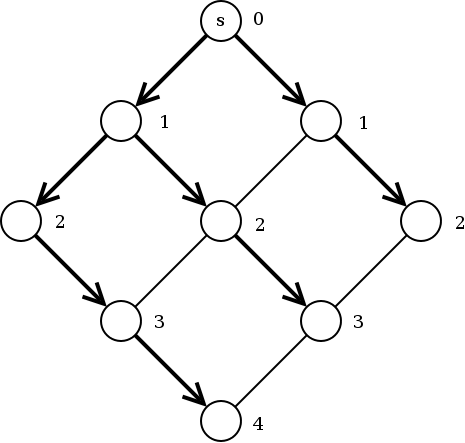
We usually analyze the space of BFS on a graph with n nodes as O(n). But if we are just looking for the distance to a given node, it can easily be optimized to O(max BFS tree level size).
BFS visits nodes in distance layers. Once you have completely visited a layer, you'll never encounter nodes from the previous layer again. Thus, you can remove those nodes from your visited set, even though we usually don't.
For example, if you do BFS in a nxn grid, you can optimize the space to O(n) instead of O(n^2), while keeping the runtime O(n^2).
This is analogous to the "rolling table" optimization for DP tabulation.
Follow-up question: is there a cleaner way to express O(max BFS tree level size)?
Image from users.cecs.anu.edu.au/~Alistair.Rendell/Teaching/apac_comp3600/module4/tutorial.xhtml