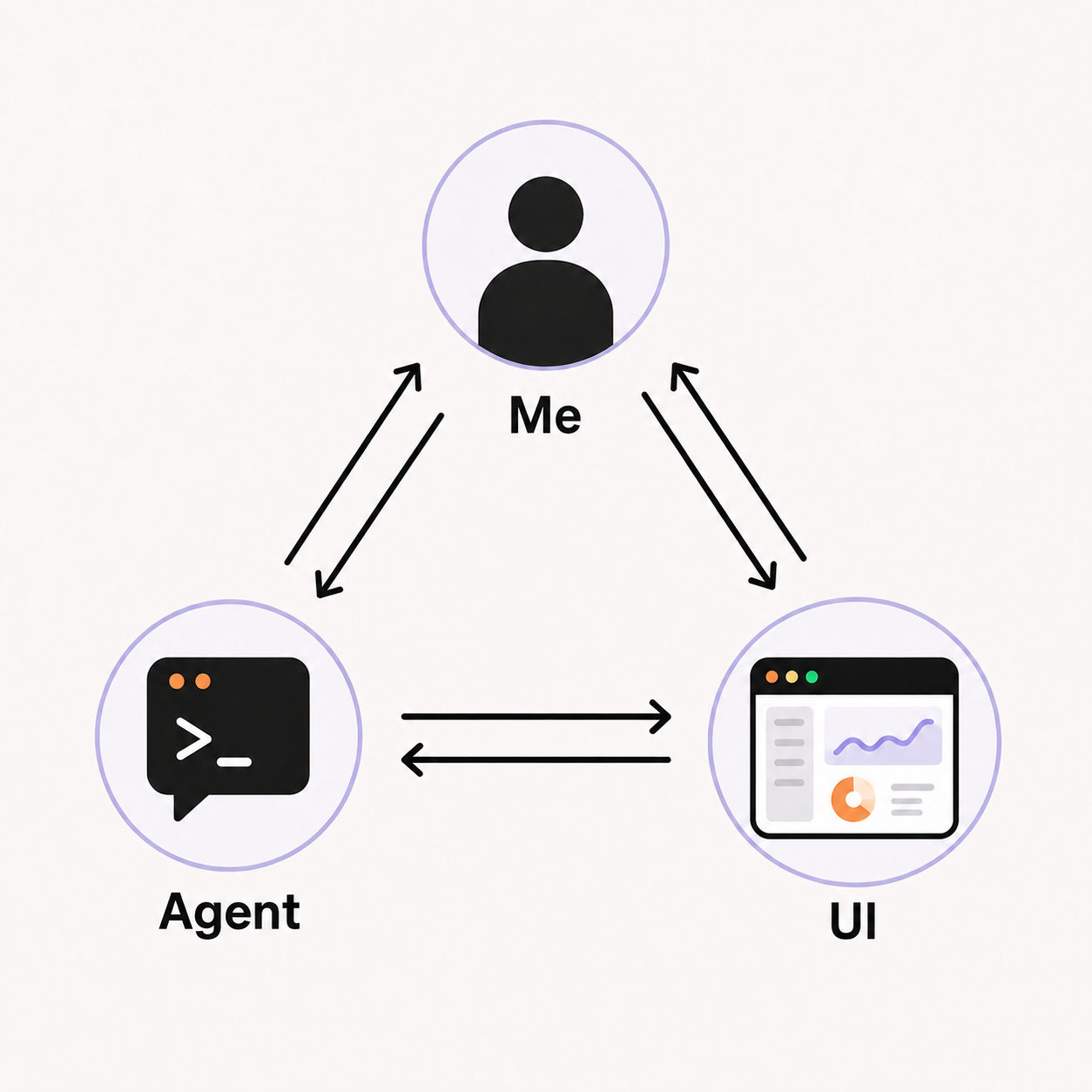
My current recipe for making software-for-one today, leveraging an always-on server.
It's a fully connected triangle: me, my agent, and the UI.
I set up a dedicated, always-on agent on my server for the new software. In my case, it's an Isomux agent, so it builds memory about the software across /clears.
I ask it to build v1: a minimal always-on web server, with state as raw files on the local file system, and a browser UI served on a port. The agent fully owns the tech stack and data format - I push back if it wants me to engage with that.
Me, my agent, and the UI all operate on the same state: the agent edits state by POST'ing to the web server, and changes I make in the UI reach the agent via an "updates" endpoint it knows to pull from.
I use the software two ways: through the UI, or by talking to the agent. The agent is best for updating state (I ramble at it with voice-to-text and let it figure out the precise operations needed); the UI is best for looking at it. Both can do both.
I keep refining the UI by talking to the agent, asking for features as I want them.
I can reach both the agent and the UI from any device, at any time. But that part isn't new, it's a principle we kinda forgot when we started running agents on our laptops.